Study Trip 2024: Austria
August 22-23, 2024
Organized by: Peter Juel Jensen, Plasser Scandinvia A/S
At the end of August 2024, Banebranchen conducted a study trip to Austria for 20 DTU students as well as interested members from the industry. The tour leader was Peter Juel Jensen from Plasser Scandinavia.
Over the course of two days, the group visited Plasser & Theurer’s manufacturing plants and track recording cars in Linz, attended a lecture on lifecycle management at Graz University of Technology (TU Graz), and visited the voestalpine rail rolling mill in Donawitz.
Banebranchen sponsored flights, hotels, and local transport for the students at a total value of approximately DKK 3,000 per student. Members of Banebranchen were welcome to join the trip while covering their own flight and hotel expenses.
The purpose of the trip was to provide students with a great shared experience through real-world site visits and to establish contact with one of Europe’s leading railway universities for inspiration and potential collaboration – naturally with the hope of nudging them towards choosing the railway sector as their future career path.
Participants evaluated the trip at 9 out of 10 stars, with comments from the majority describing it as “fantastically exciting and inspiring,” “a once in a lifetime experience,” and praising the “great guides who gave detailed tours.” One participant followed up with a LinkedIn post, concluding:
”This trip deepened my passion for railway engineering, leaving me excited for what’s ahead”.
This confirms that the trip’s objective was achieved for at least one participant, who is likely well on the way toward a future career in the railway industry.
Visit to Plasser & Theurer’s Manufacturing Plants in Linz
Plasser & Theurer is the world’s largest supplier of track maintenance machinery – tamping machines, ballast cleaners, track renewal trains, motor tower cars, etc. Since 1953, when Plasser & Theurer produced the first hydraulic machine for railway maintenance (which until then had been performed manually), they have delivered more than 16,000 machines operating in over 110 countries worldwide today.
The main factory is located in Austria’s third-largest city, Linz, about a 2.5-hour drive from Vienna.
The group went on a guided tour through most of the factory buildings. The tour began by showcasing how steel plates are welded together to form the main load-bearing frame structures, how the electronics are assembled, hydraulic cylinders manufactured, and engines installed, before everything comes together in “final assembly” into large, complex machinery. The guided walking tour was conducted using audio headsets and two guides.
Visit to Plasser & Theurer’s Measurement Vehicles in Linz Wegscheid
Following the factory visit, the group drove a few kilometers south to a major freight yard named Linz Wegscheid.
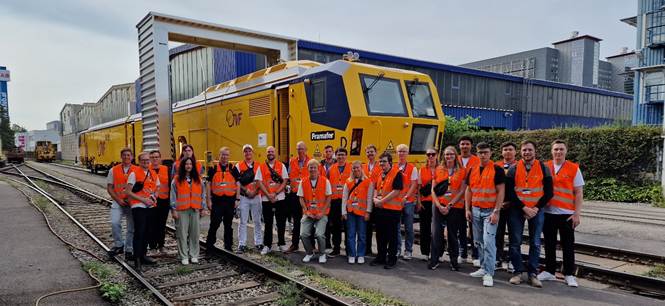
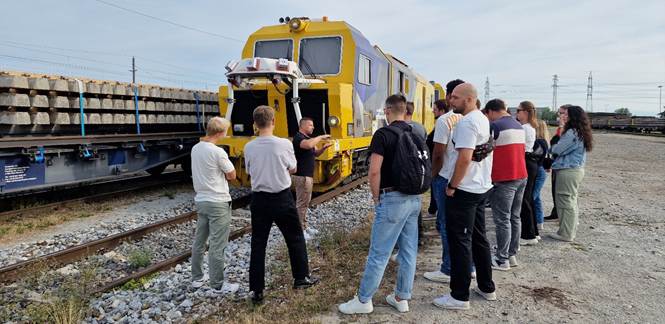
Here, two of Plasser & Theurer’s most advanced measurement vehicles had been made available for a guided tour, including the opportunity to inspect the interior.
The group received a comprehensive introduction to the various measurement systems and their applications, including relative track geometry, laser scanning, ground-penetrating radar (GPR), reference point measurement, rail profiles, turnouts, as well as photographic and video inspection systems.
Lecture at Graz University of Technology (TU Graz)
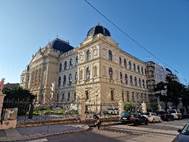
After breakfast, the bus took the group on a short drive to the city center of Austria’s second-largest city, Graz, to visit the university.
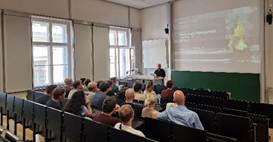
Here, Professor and Head of Institute Stefan Marschnig delivered a lecture on “Track Asset Management” – or, as stated on the meeting room door: “LCM für Dänen” (Lifecycle Management for Danes).
TU Graz’s Institute of Railway Engineering and Transport Economy is renowned across the European railway sector. They undertake numerous research projects in close collaboration with industry partners and infrastructure managers. Their core principle is that all new technology and methods must be directly tied to economic value; otherwise, it is difficult to convince decision-makers of their merit.
The students received a lecture on the principles and methodology behind track infrastructure asset management utilizing master data and measurement data.
There was widespread interest and active Q&A engagement from both students and industry participants. The session may even have laid the groundwork for future international collaboration should any students require it.
TU Graz kindly provided to-go lunches. While only 30 minutes had originally been allocated for lunch, this thoughtful gesture saved the group from having to locate a supermarket to buy food.
Visit to voestalpine’s Rail Rolling Mill in Donawitz
About an hour’s drive north of Graz, in the town of Donawitz near Leoben, lies an enormous steelworks belonging to the former national, now privatized, United Austrian Steelworks (voestalpine).
The facility encompasses mining, logistics, a blast furnace, casting, and a rail rolling mill. On this trip, time only permitted a visit to the rail rolling mill – the most relevant section for the trip’s theme – though for future visits, exploring the full site could be considered (as tours covering the entire facility are available).
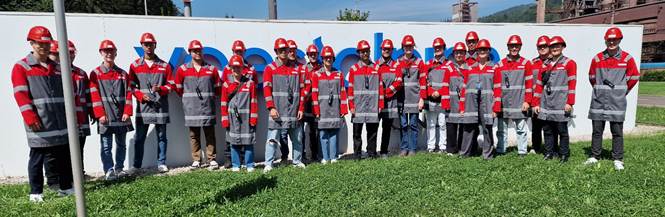
The visit opened at voestalpine’s visitor center with an introductory film covering the facility’s operations, a presentation on sustainability initiatives (the company aims to achieve CO₂-neutral steel production by 2050), and a safety briefing. Equipped with safety gear and audio guides, the group was taken on a guided tour of the rail rolling mill. The entire process – from heating steel blooms to rolling and cooling – could be observed directly from walkways just a few meters above the glowing metal, where radiant heat reaching 1,200 °C was clearly felt.